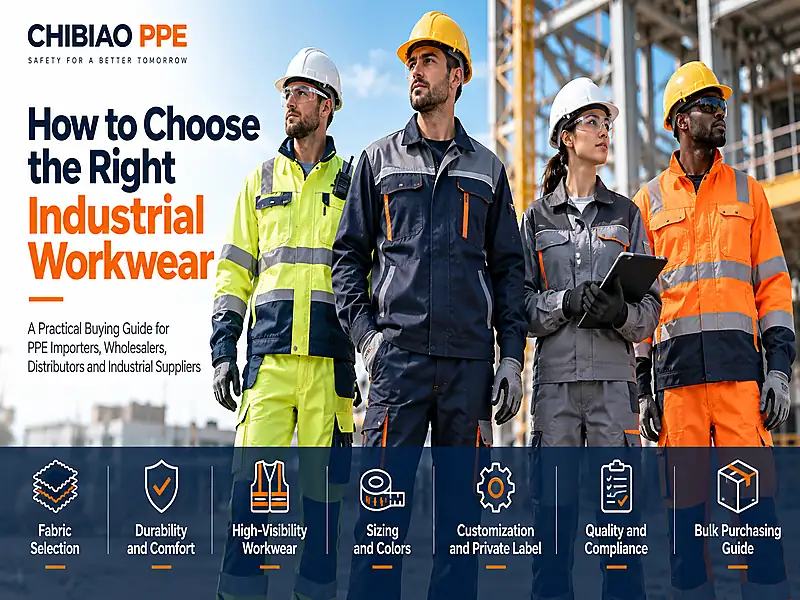
Choosing the right industrial workwear helps businesses protect workers, improve comfort, and maintain a professional appearance. For PPE importers, wholesalers, distributors, and industrial suppliers, understanding fabric options, garment construction, visibility requirements, and customization possibilities is essential when sourcing workwear in bulk.
This guide explains the key factors to consider when selecting industrial workwear for different workplace applications.
1. Identify the Working Environment
Start by understanding where the workwear will be used and what conditions workers will face.
- Manufacturing and workshops: Consider durability, freedom of movement, and resistance to everyday wear.
- Construction sites: Workwear may need reinforced areas, practical pockets, and high-visibility features depending on the job.
- Warehousing and logistics: Lightweight fabrics, comfort, and ease of movement can be important for workers who spend long periods standing or walking.
- Outdoor work: Consider weather conditions, fabric weight, and whether additional protection from wind or rain is required.
- Roadside and low-light work: High-visibility garments may be necessary based on the workplace risk assessment and applicable requirements.
Select workwear according to the actual working environment rather than appearance alone.
2. Choose the Right Fabric
Fabric selection affects durability, breathability, comfort, maintenance, and cost.
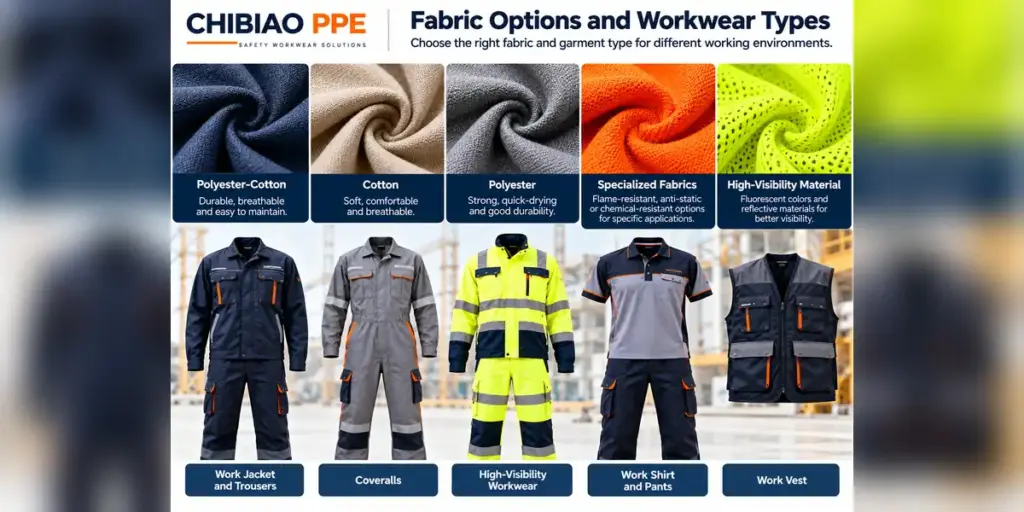
Polyester-Cotton Blends
Polyester-cotton blends are commonly used for workwear because they combine properties of both fibers. The actual performance depends on the fiber ratio, fabric construction, and finishing.
Cotton Workwear
Cotton garments may be suitable for applications where softness and breathability are priorities. Buyers should also consider shrinkage, drying time, durability, and maintenance requirements.
Polyester Workwear
Polyester fabrics can offer useful durability and drying characteristics. Suitability depends on the fabric weight, construction, finishing, and intended work environment.
Specialized Fabrics
Some applications may require fabrics with specified flame-resistant, antistatic, chemical-resistant, or other protective properties. These claims must be verified against the garment’s documented specifications and applicable standards. Ordinary workwear should not be assumed to provide specialized protection.
When comparing suppliers, request the fabric composition, fabric weight, construction details, and care instructions for the specific product.
3. Evaluate Durability and Comfort
Workwear must be practical for the tasks workers perform every day.
Review the following details:
- Seams and stitching: Check seam construction and workmanship.
- Reinforced areas: Consider reinforcement at the knees, elbows, or other high-wear areas where appropriate.
- Closures: Evaluate zippers, buttons, snaps, and hook-and-loop fasteners.
- Pockets: Confirm the number, size, placement, and intended use of pockets.
- Mobility: Ensure the garment allows workers to bend, reach, kneel, and move comfortably.
- Breathability: Consider temperature, humidity, and the intensity of the work.
- Maintenance: Confirm washing instructions and any relevant limitations.
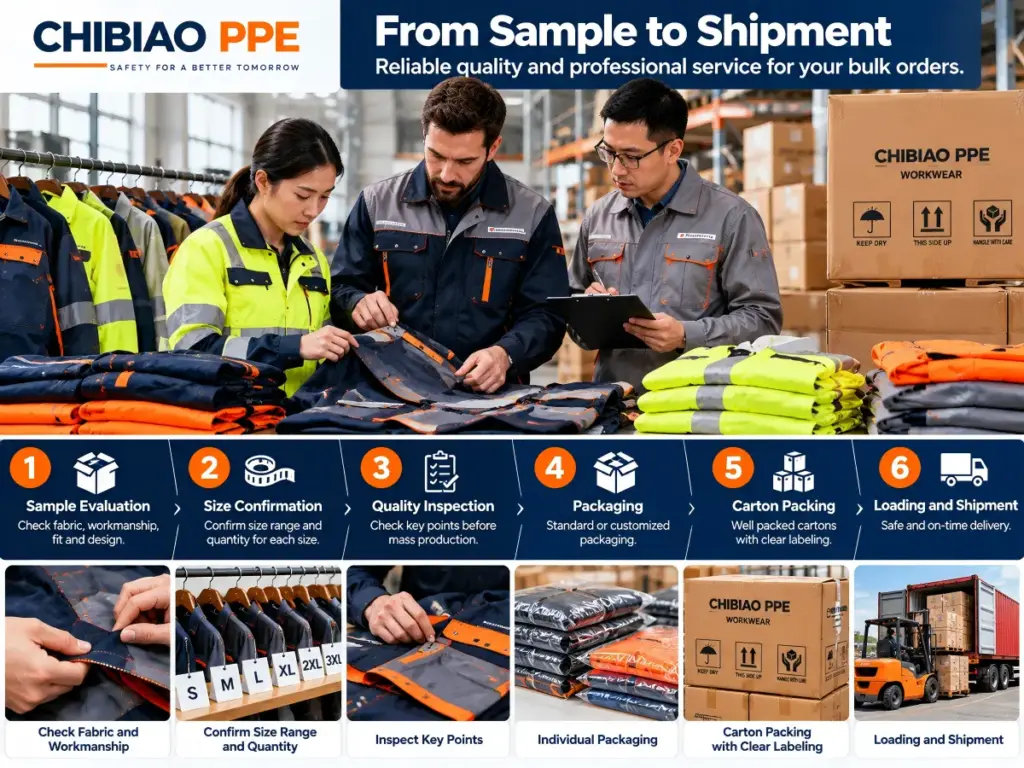
Samples should be evaluated for fit, finishing, and comfort before a large order is confirmed.
4. Understand High-Visibility Workwear
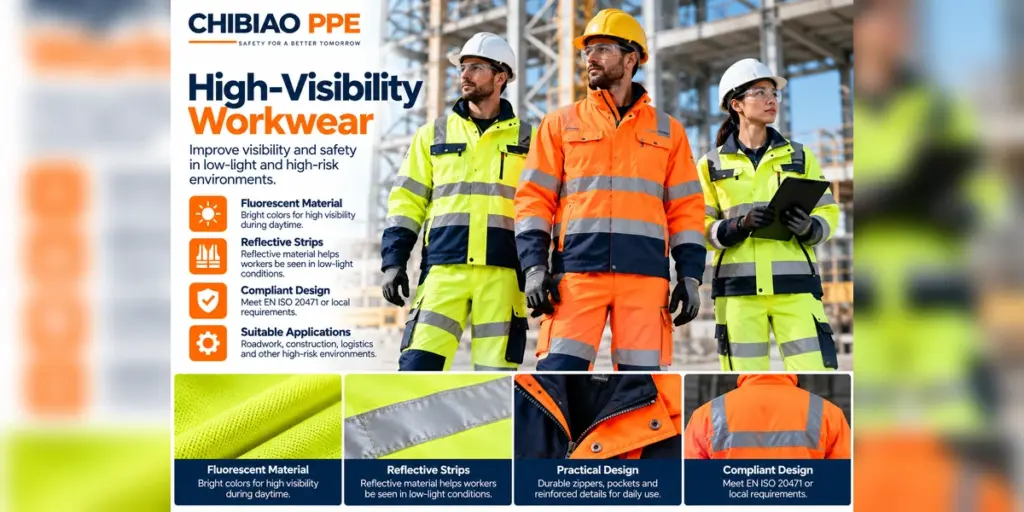
High-visibility workwear is designed to make workers more conspicuous in relevant environments. It is commonly considered for roadwork, construction, logistics, and other jobs where visibility is an important safety factor.
When selecting high-visibility garments, review:
- Fluorescent background material.
- Reflective material and its placement.
- Garment design and coverage.
- Intended working conditions, including daylight, darkness, and low-light environments.
- Applicable standards and the required performance class for the intended use.
EN ISO 20471 is a commonly referenced standard for high-visibility clothing. Requirements depend on the application and applicable regulations. Do not assume that a fluorescent color or reflective strips alone establish compliance. Verify the relevant documentation for the exact garment.
5. Select the Right Sizes and Colors
Correct sizing helps improve comfort, movement, and worker acceptance.
Before placing a bulk order, confirm:
- The sizing system used by the supplier.
- Available sizes and garment measurements.
- The quantity required for each size.
- Whether garments will be worn over other clothing.
- Available standard colors and color consistency.
- Whether a size set or samples can be evaluated before production.
For international orders, do not rely on size labels alone. Request a size chart with actual garment measurements and confirm the measurement method.
6. Consider Customization and Private Label Options
Many importers and distributors require workwear customized for their customers or markets.
Depending on the supplier’s capabilities, options may include:
- Company logos through embroidery or printing.
- Custom colors or color combinations.
- Different pocket layouts or garment details.
- Woven labels, printed labels, or branded packaging.
- Individual packaging and carton markings.
Before production, approve the artwork, logo placement, color references, garment specifications, and any packaging samples. Confirm whether customization affects minimum order quantities, pricing, or lead time.
7. Verify Quality and Compliance Requirements
Workwear requirements depend on the garment’s intended function and destination market.
Before purchasing, verify:
- Product specifications and fabric composition.
- Relevant test reports or certificates where required.
- The exact scope of any claimed protective performance.
- Garment labeling and care instructions.
- Model identification and consistency between samples and production.
- Destination-market requirements for specialized protective clothing.
If workwear is intended to provide protection against flame, heat, chemicals, static electricity, or other specific hazards, confirm that the exact garment has the necessary documented performance. General-purpose uniforms should not be treated as protective clothing for hazards they were not designed and tested to address.
8. Compare Price and Total Purchasing Cost
A low unit price may not represent the best overall purchasing value. Compare products with equivalent specifications, construction, performance requirements, and delivery terms.
Include the following in your cost evaluation:
- Unit price and minimum order quantity (MOQ).
- Sample and testing costs, where applicable.
- Logo application and customization charges.
- Individual packaging, labeling, and carton requirements.
- Production lead time.
- Freight, insurance, duties, and other applicable import costs.
- Inspection requirements and arrangements for non-conforming goods.
Request quotations using the same product specifications and order quantities so that supplier comparisons are meaningful.
9. Evaluate the Supplier
A dependable workwear supplier should be able to explain its products, provide clear specifications, communicate production requirements, and confirm realistic delivery arrangements.
Before placing a bulk order, consider whether the supplier can:
- Provide detailed fabric and garment specifications.
- Supply samples for evaluation.
- Confirm customization capabilities and limitations.
- Provide relevant product documentation.
- Explain quality inspection procedures.
- Confirm production capacity and lead times.
- Maintain agreed specifications for repeat orders.
- Verify its legal business details and payment information.
For new suppliers, independently verify the business identity and payment instructions before transferring funds.
10. Practical Bulk-Purchasing Checklist
Use this checklist before confirming an industrial workwear order.
- Application: Confirm the intended workplace and working conditions.
- Garment Type: Specify jackets, trousers, coveralls, vests, or other required garments.
- Fabric: Confirm composition, fabric weight, construction, and care instructions.
- Protective Features: Identify any required visibility or specialized protective performance.
- Compliance: Verify applicable standards and supporting documentation.
- Sizes and Colors: Confirm size distribution, measurements, and color requirements.
- Samples: Evaluate fit, comfort, workmanship, and material quality.
- Customization: Approve logo artwork, placement, labels, and packaging.
- Quotation: Confirm unit price, MOQ, currency, and additional charges.
- Packaging: Specify individual packaging, carton quantities, and shipping marks.
- Delivery: Confirm production lead time, shipment schedule, and delivery terms.
- Inspection: Agree on quality criteria and how non-conforming products will be handled.
- Payment: Verify supplier details, payment terms, and the Proforma Invoice (PI).
- Repeat Orders: Establish how garment specifications and quality consistency will be maintained.
Completing this checklist helps reduce purchasing misunderstandings and supports more consistent bulk procurement.
Conclusion
Choosing suitable industrial workwear requires a clear understanding of the working environment, fabric characteristics, garment construction, fit, visibility requirements, and applicable compliance obligations.
For PPE importers, wholesalers, and distributors, defining specifications before requesting quotations helps improve product comparisons, manage bulk purchasing risks, and support more consistent repeat orders.
Looking for industrial workwear for your market? Contact CHIBIAO PPE to discuss your garment specifications, size range, customization options, packaging requirements, and bulk purchasing needs.