How to Choose the Right Safety Goggles for Industrial Use

Choosing the right protective eyewear is an important part of workplace safety. Industrial environments may expose workers to flying particles, dust, liquid splashes, and other eye hazards. For PPE importers, wholesalers, distributors, and industrial suppliers, understanding the differences between safety glasses and safety goggles helps ensure that the products they source match the intended application.

This guide explains the key factors to consider when selecting industrial eye protection for bulk purchasing.
1. Identify the Eye Hazards

Start by identifying the hazards workers may encounter in their daily tasks. Different hazards require different types of eye protection.

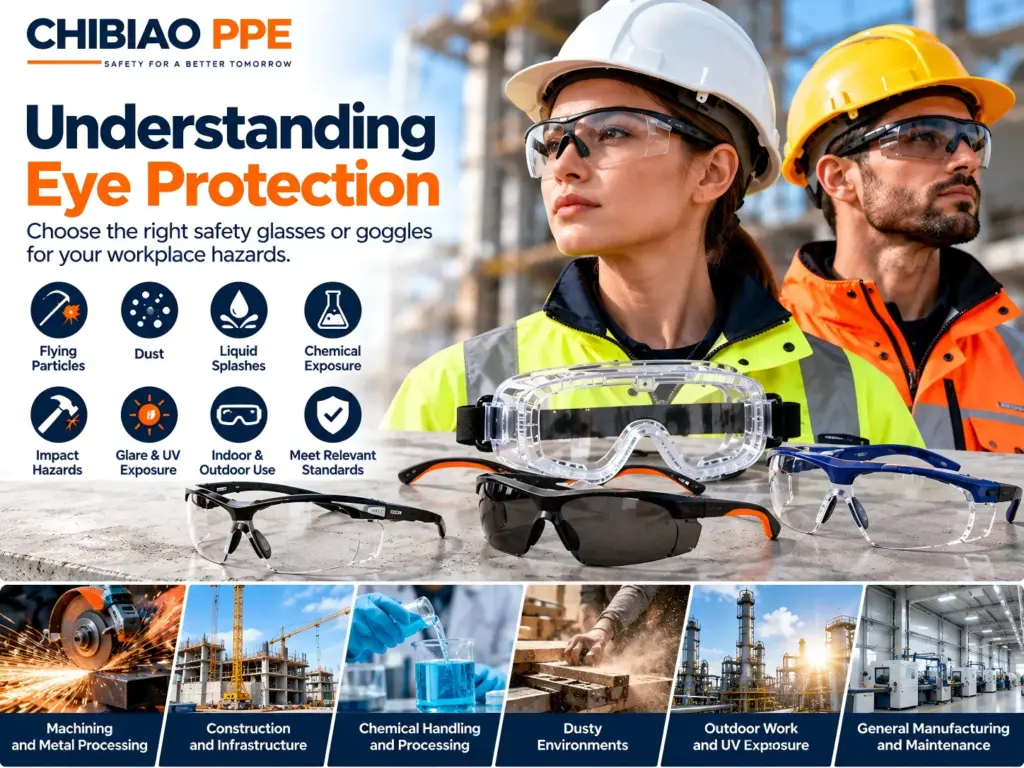
  • Flying particles: Grinding, drilling, cutting, and machining may create particles that can strike the eyes.
  • Dust and airborne debris: Some manufacturing, construction, and material-handling tasks require protection against dust and particles.
  • Liquid splashes: Cleaning, processing, and certain industrial operations may expose workers to splashes.
  • Chemical exposure: Where chemicals may contact the eyes, select eyewear specifically suitable for the chemical and task.
  • Impact hazards: Confirm the required impact protection based on the work being performed.
  • Outdoor glare and light exposure: Some applications may require suitable tinted lenses or specialized optical protection.

A product designed for one hazard should not automatically be assumed suitable for another. Begin with a workplace risk assessment and identify the required level of protection.

2. Understand the Difference Between Safety Glasses and Safety Goggles

Safety glasses and safety goggles serve different purposes and should be selected according to the workplace hazards.

Safety Glasses

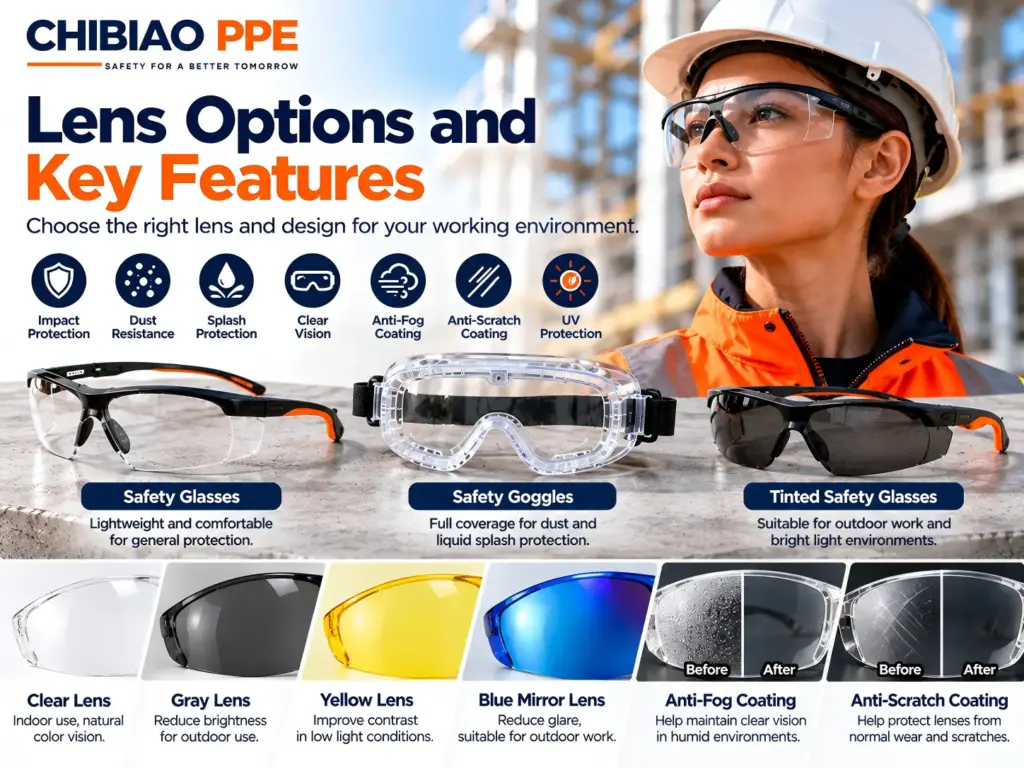
Safety glasses typically feature protective lenses with frames or side protection. They may be suitable for tasks where impact protection is required and the design provides the necessary coverage.

When evaluating safety glasses, consider lens coverage, side protection, fit, visibility, and compatibility with other personal protective equipment.

Safety Goggles

Safety goggles generally fit more closely around the eyes and may provide greater coverage against dust or liquid splashes, depending on their design.

Buyers should evaluate the sealing design, ventilation, lens clarity, fit, and compatibility with respirators, helmets, and other PPE.

Over-the-Glasses Goggles

Some designs are intended to be worn over prescription glasses. Confirm the internal dimensions, comfort, field of vision, and compatibility with the user’s existing eyewear before ordering in bulk.

Neither safety glasses nor goggles should be selected by appearance alone. Verify that the exact product is suitable for the intended hazards and meets the applicable requirements.

3. Choose the Right Lens Material and Design

Lens material and construction influence impact performance, weight, optical clarity, and comfort.

Polycarbonate Lenses

Polycarbonate is commonly used for protective eyewear because it can provide impact-resistant properties when the finished product is appropriately designed and tested. Buyers should verify the performance of the complete eyewear product rather than relying on the material name alone.

Clear Lenses

Clear lenses are commonly used for indoor environments where maintaining natural color perception and visibility is important.

Tinted Lenses

Tinted lenses may be suitable for certain outdoor or bright-light environments. The tint should match the application, and ordinary tinted lenses should not be assumed to provide certified protection against welding radiation or other specialized optical hazards.

Lens Coatings

Depending on the product, coatings may include anti-scratch or anti-fog features. Buyers should confirm the coating type, its intended benefits, and any care or cleaning limitations.

When comparing models, consider optical clarity, distortion, field of vision, lens replacement options, and the conditions under which the eyewear will be used.
4. Evaluate Coverage, Fit, and Comfort

Protective eyewear must fit properly to provide its intended coverage and remain comfortable during use.

Check the following features:

  • Eye coverage: Confirm that the design provides suitable coverage for the identified hazards.
  • Frame fit: Review the bridge, temples, strap, and contact points.
  • Adjustability: Determine whether the design allows useful adjustments for different users.
  • Ventilation: For goggles, assess ventilation design and its suitability for the task.
  • Field of vision: Ensure the product does not unnecessarily restrict visibility.
  • Comfort: Evaluate weight, pressure points, and suitability for extended wear.
  • PPE compatibility: Check compatibility with hard hats, hearing protection, respirators, and other equipment.

Where possible, evaluate samples with the other PPE that workers will wear at the same time.

5. Understand Anti-Fog and Anti-Scratch Features

Fogging can affect visibility, especially in humid environments, during temperature changes, or when workers wear respiratory protection. Anti-fog features may help, but their effectiveness depends on the product design, coating, conditions, and maintenance.

Anti-scratch coatings may help protect lens surfaces during normal use, but they do not make lenses scratch-proof.

Before bulk purchasing, clarify:

  • Whether anti-fog or anti-scratch treatment is included.
  • Whether the coating has supporting product documentation.
  • The recommended cleaning method.
  • Whether cleaning agents may damage the lens or coating.
  • The expected replacement and maintenance requirements.

Do not assume that all lenses with similar appearances provide the same performance.

6. Verify Applicable Standards and Documentation

Protective eyewear requirements depend on the destination market and the intended application.

EN ISO 16321 is a relevant international series for eye and face protection in occupational use. ANSI/ISEA Z87.1 is also commonly referenced for occupational and educational eye and face protection in the United States. Buyers should confirm the applicable edition and requirements for their market.

Before purchasing, verify:

  • The applicable standard and edition.
  • The exact model and declared protection features.
  • Relevant test reports, certificates, or declarations where required.
  • Product markings and identification.
  • Whether the supporting documentation covers the specific product being offered.

Do not assume that every product from a supplier has the same certification or performance level. Verify the scope of the documentation and confirm that it matches the model and intended use.

7. Consider Cleaning, Maintenance, and Replacement

Protective eyewear needs appropriate care to remain usable and provide its intended performance.

Before selecting a product, ask the supplier about:

  • Recommended cleaning procedures.
  • Compatible cleaning agents.
  • Storage requirements.
  • Lens replacement options, where applicable.
  • Inspection criteria for scratched, damaged, or degraded eyewear.
  • Replacement intervals based on workplace policy and product instructions.

Damaged or badly scratched eyewear may impair visibility and should be assessed according to the manufacturer’s instructions and workplace safety procedures.

8. Compare Price and Total Purchasing Cost

For importers and distributors, unit price is only one part of the purchasing decision. Compare products with equivalent specifications, protection requirements, packaging, and delivery terms.

Include the following in your evaluation:

  • Unit price and minimum order quantity (MOQ).
  • Sample and testing costs, where applicable.
  • Lens options and coating specifications.
  • Individual packaging and carton quantities.
  • Logo, labeling, and private-label requirements.
  • Freight, insurance, duties, and other applicable import costs.
  • Inspection arrangements and procedures for non-conforming products.

Request quotations based on the same product requirements to make supplier comparisons more meaningful.

9. Evaluate the Supplier

A dependable PPE supplier should provide clear specifications, relevant product documentation, realistic lead times, and consistent communication.

Before placing a bulk order, consider whether the supplier can:

  • Explain the differences between its eyewear models.
  • Provide samples for evaluation.
  • Supply model-specific specifications and supporting documents.
  • Confirm available lens types and coatings.
  • Support agreed packaging and labeling requirements.
  • Explain quality inspection procedures.
  • Maintain consistent specifications for repeat orders.
  • Verify its legal business details and payment information.

For new suppliers, independently verify business identity and payment instructions before transferring funds.
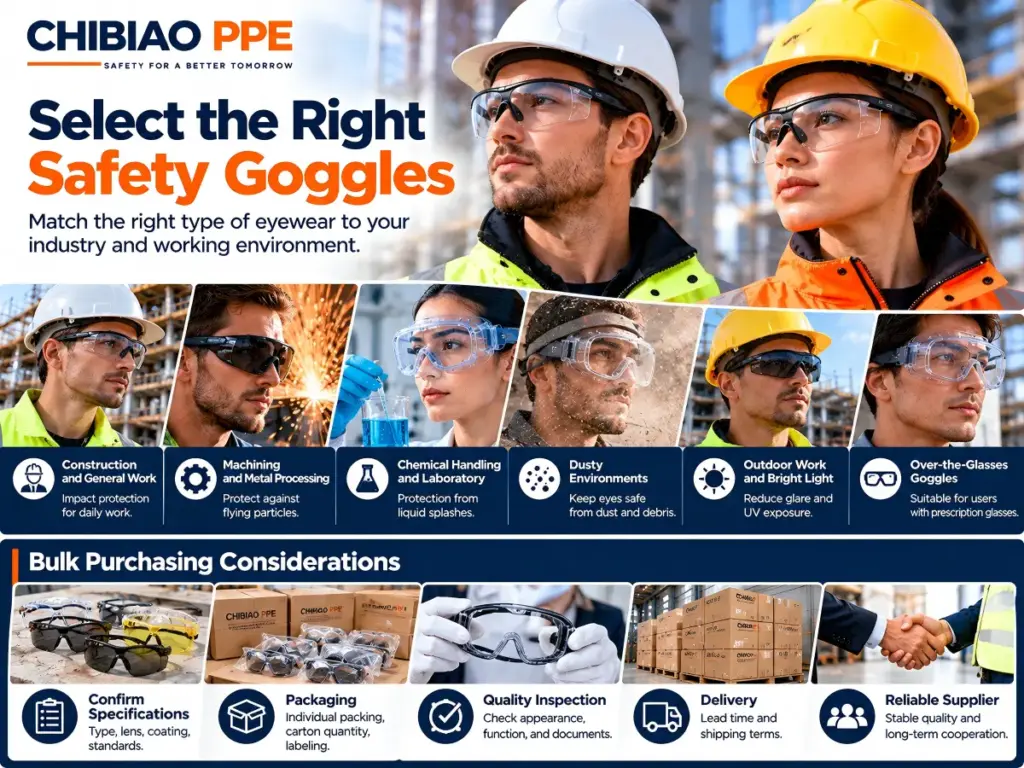
10. Practical Bulk-Purchasing Checklist

Use this checklist before confirming an industrial protective eyewear order.

  • Application: Identify the workplace tasks and eye hazards.
  • Product Type: Confirm whether safety glasses, goggles, or over-the-glasses designs are required.
  • Protection: Specify the required impact, dust, splash, or other protective performance.
  • Lens: Confirm lens material, color, optical clarity, and coating requirements.
  • Fit: Evaluate coverage, comfort, adjustability, and compatibility with other PPE.
  • Standards: Verify applicable standards and destination-market requirements.
  • Documentation: Check prod
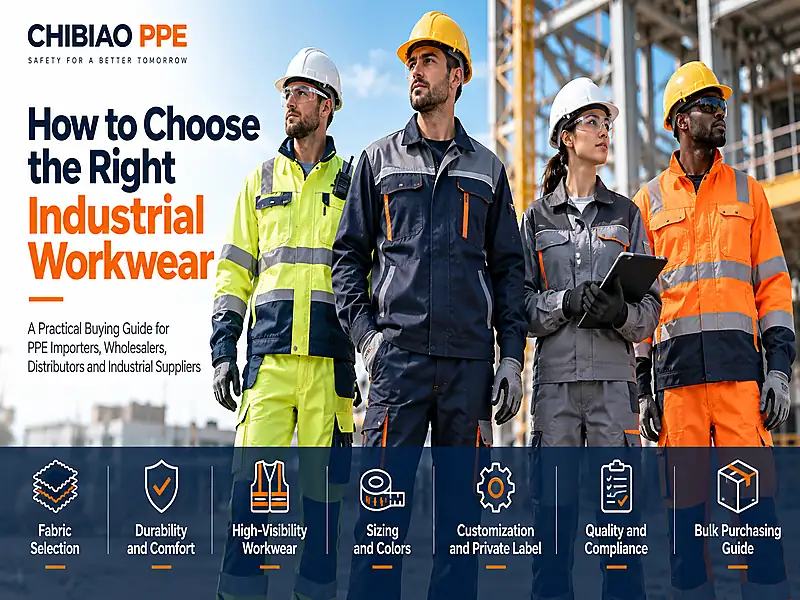
How to Choose the Right Industrial Workwear

Choosing the right industrial workwear helps businesses protect workers, improve comfort, and maintain a professional appearance. For PPE importers, wholesalers, distributors, and industrial suppliers, understanding fabric options, garment construction, visibility requirements, and customization possibilities is essential when sourcing workwear in bulk.

This guide explains the key factors to consider when selecting industrial workwear for different workplace applications.

1. Identify the Working Environment

Start by understanding where the workwear will be used and what conditions workers will face.

  • Manufacturing and workshops: Consider durability, freedom of movement, and resistance to everyday wear.
  • Construction sites: Workwear may need reinforced areas, practical pockets, and high-visibility features depending on the job.
  • Warehousing and logistics: Lightweight fabrics, comfort, and ease of movement can be important for workers who spend long periods standing or walking.
  • Outdoor work: Consider weather conditions, fabric weight, and whether additional protection from wind or rain is required.
  • Roadside and low-light work: High-visibility garments may be necessary based on the workplace risk assessment and applicable requirements.

Select workwear according to the actual working environment rather than appearance alone.

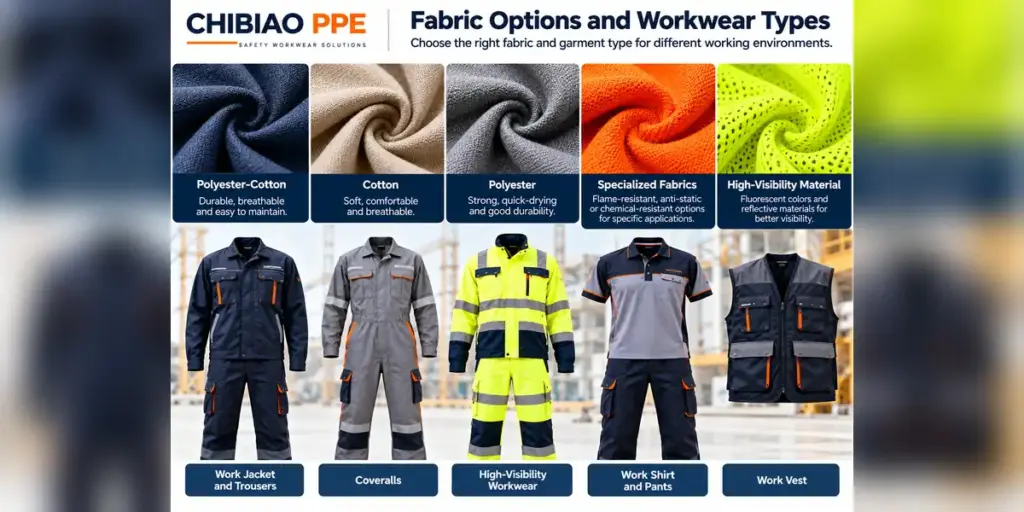
2. Choose the Right Fabric

Fabric selection affects durability, breathability, comfort, maintenance, and cost.

Polyester-Cotton Blends

Polyester-cotton blends are commonly used for workwear because they combine properties of both fibers. The actual performance depends on the fiber ratio, fabric construction, and finishing.

Cotton Workwear

Cotton garments may be suitable for applications where softness and breathability are priorities. Buyers should also consider shrinkage, drying time, durability, and maintenance requirements.

Polyester Workwear

Polyester fabrics can offer useful durability and drying characteristics. Suitability depends on the fabric weight, construction, finishing, and intended work environment.

Specialized Fabrics

Some applications may require fabrics with specified flame-resistant, antistatic, chemical-resistant, or other protective properties. These claims must be verified against the garment’s documented specifications and applicable standards. Ordinary workwear should not be assumed to provide specialized protection.

When comparing suppliers, request the fabric composition, fabric weight, construction details, and care instructions for the specific product.

3. Evaluate Durability and Comfort

Workwear must be practical for the tasks workers perform every day.

Review the following details:

  • Seams and stitching: Check seam construction and workmanship.
  • Reinforced areas: Consider reinforcement at the knees, elbows, or other high-wear areas where appropriate.
  • Closures: Evaluate zippers, buttons, snaps, and hook-and-loop fasteners.
  • Pockets: Confirm the number, size, placement, and intended use of pockets.
  • Mobility: Ensure the garment allows workers to bend, reach, kneel, and move comfortably.
  • Breathability: Consider temperature, humidity, and the intensity of the work.
  • Maintenance: Confirm washing instructions and any relevant limitations.

Samples should be evaluated for fit, finishing, and comfort before a large order is confirmed.

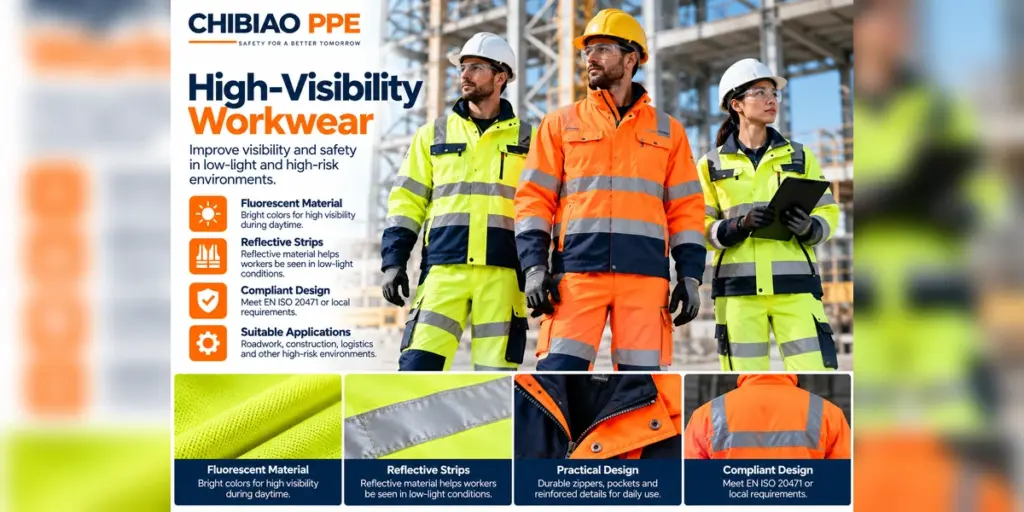
4. Understand High-Visibility Workwear

High-visibility workwear is designed to make workers more conspicuous in relevant environments. It is commonly considered for roadwork, construction, logistics, and other jobs where visibility is an important safety factor.

When selecting high-visibility garments, review:

  • Fluorescent background material.
  • Reflective material and its placement.
  • Garment design and coverage.
  • Intended working conditions, including daylight, darkness, and low-light environments.
  • Applicable standards and the required performance class for the intended use.

EN ISO 20471 is a commonly referenced standard for high-visibility clothing. Requirements depend on the application and applicable regulations. Do not assume that a fluorescent color or reflective strips alone establish compliance. Verify the relevant documentation for the exact garment.

5. Select the Right Sizes and Colors

Correct sizing helps improve comfort, movement, and worker acceptance.

Before placing a bulk order, confirm:

  • The sizing system used by the supplier.
  • Available sizes and garment measurements.
  • The quantity required for each size.
  • Whether garments will be worn over other clothing.
  • Available standard colors and color consistency.
  • Whether a size set or samples can be evaluated before production.

For international orders, do not rely on size labels alone. Request a size chart with actual garment measurements and confirm the measurement method.

6. Consider Customization and Private Label Options

Many importers and distributors require workwear customized for their customers or markets.

Depending on the supplier’s capabilities, options may include:

  • Company logos through embroidery or printing.
  • Custom colors or color combinations.
  • Different pocket layouts or garment details.
  • Woven labels, printed labels, or branded packaging.
  • Individual packaging and carton markings.

Before production, approve the artwork, logo placement, color references, garment specifications, and any packaging samples. Confirm whether customization affects minimum order quantities, pricing, or lead time.

7. Verify Quality and Compliance Requirements

Workwear requirements depend on the garment’s intended function and destination market.

Before purchasing, verify:

  • Product specifications and fabric composition.
  • Relevant test reports or certificates where required.
  • The exact scope of any claimed protective performance.
  • Garment labeling and care instructions.
  • Model identification and consistency between samples and production.
  • Destination-market requirements for specialized protective clothing.

If workwear is intended to provide protection against flame, heat, chemicals, static electricity, or other specific hazards, confirm that the exact garment has the necessary documented performance. General-purpose uniforms should not be treated as protective clothing for hazards they were not designed and tested to address.

8. Compare Price and Total Purchasing Cost

A low unit price may not represent the best overall purchasing value. Compare products with equivalent specifications, construction, performance requirements, and delivery terms.

Include the following in your cost evaluation:

  • Unit price and minimum order quantity (MOQ).
  • Sample and testing costs, where applicable.
  • Logo application and customization charges.
  • Individual packaging, labeling, and carton requirements.
  • Production lead time.
  • Freight, insurance, duties, and other applicable import costs.
  • Inspection requirements and arrangements for non-conforming goods.

Request quotations using the same product specifications and order quantities so that supplier comparisons are meaningful.

9. Evaluate the Supplier

A dependable workwear supplier should be able to explain its products, provide clear specifications, communicate production requirements, and confirm realistic delivery arrangements.

Before placing a bulk order, consider whether the supplier can:

  • Provide detailed fabric and garment specifications.
  • Supply samples for evaluation.
  • Confirm customization capabilities and limitations.
  • Provide relevant product documentation.
  • Explain quality inspection procedures.
  • Confirm production capacity and lead times.
  • Maintain agreed specifications for repeat orders.
  • Verify its legal business details and payment information.

For new suppliers, independently verify the business identity and payment instructions before transferring funds.

10. Practical Bulk-Purchasing Checklist

Use this checklist before confirming an industrial workwear order.

  • Application: Confirm the intended workplace and working conditions.
  • Garment Type: Specify jackets, trousers, coveralls, vests, or other required garments.
  • Fabric: Confirm composition, fabric weight, construction, and care instructions.
  • Protective Features: Identify any required visibility or specialized protective performance.
  • Compliance: Verify applicable standards and supporting documentation.
  • Sizes and Colors: Confirm size distribution, measurements, and color requirements.
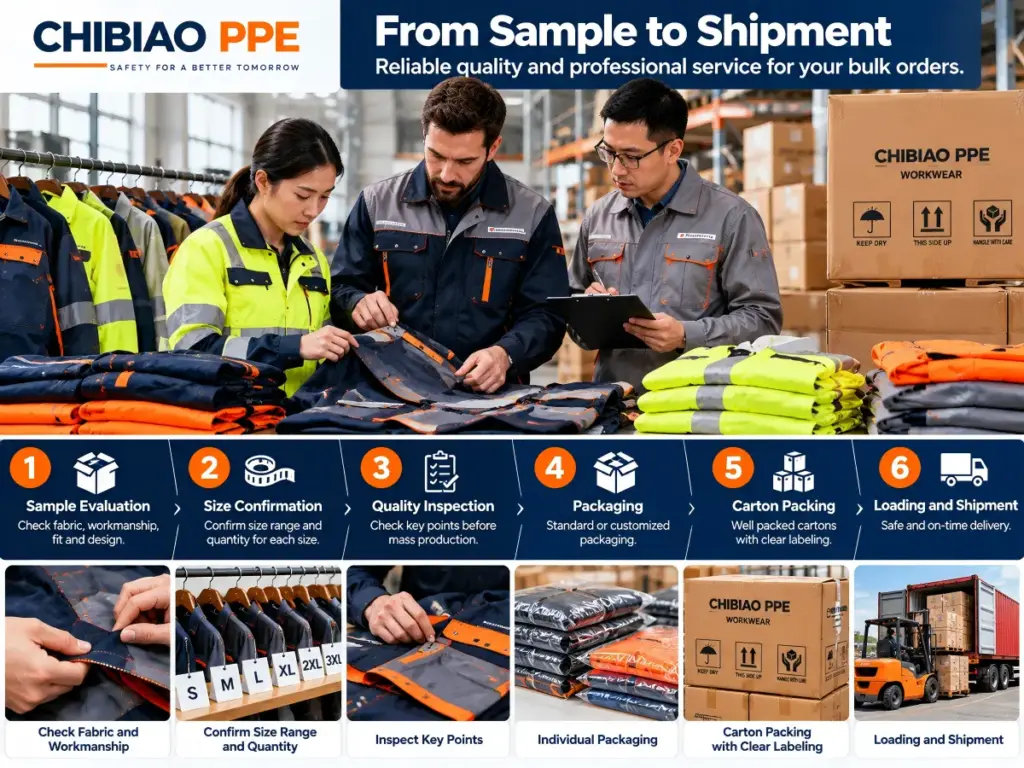
  • Samples: Evaluate fit, comfort, workmanship, and material quality.
  • Customization: Approve logo artwork, placement, labels, and packaging.
  • Quotation: Confirm unit price, MOQ, currency, and additional charges.
  • Packaging: Specify individual packaging, carton quantities, and shipping marks.
  • Delivery: Confirm production lead time, shipment schedule, and delivery terms.
  • Inspection: Agree on quality criteria and how non-conforming products will be handled.
  • Payment: Verify supplier details, payment terms, and the Proforma Invoice (PI).
  • Repeat Orders: Establish how garment specifications and quality consistency will be maintained.

Completing this checklist helps reduce purchasing misunderstandings and supports more consistent bulk procurement.

Conclusion

Choosing suitable industrial workwear requires a clear understanding of the working environment, fabric characteristics, garment construction, fit, visibility requirements, and applicable compliance obligations.

For PPE importers, wholesalers, and distributors, defining specifications before requesting quotations helps improve product comparisons, manage bulk purchasing risks, and support more consistent repeat orders.

Looking for industrial workwear for your market? Contact CHIBIAO PPE to discuss your garment specifications, size range, customization options, packaging requirements, and bulk purchasing needs.

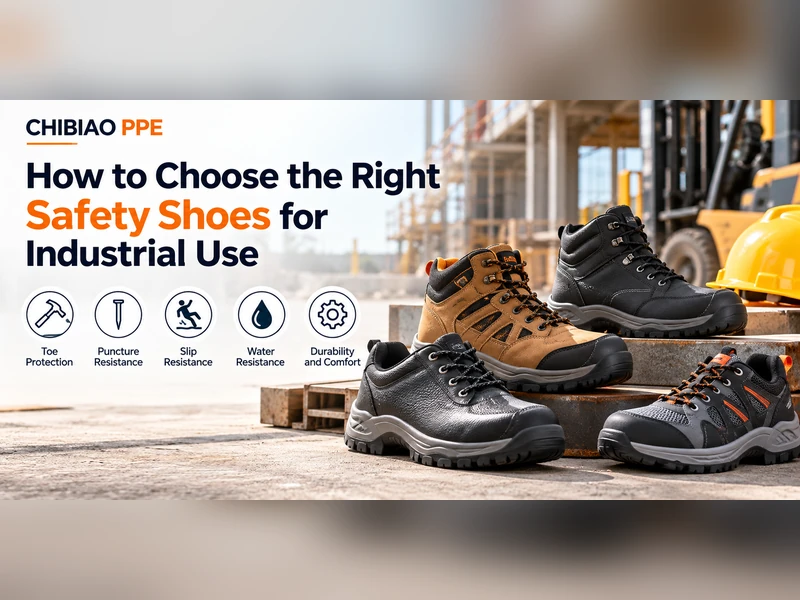
How to Choose the Right Safety Shoes for Industrial Use

Choosing the right safety shoes is essential for protecting workers, improving workplace comfort, and supporting compliance with job-specific safety requirements. For PPE importers, wholesalers, distributors, and industrial suppliers, understanding the differences between safety footwear types helps make better purchasing decisions and reduces the risk of selecting unsuitable products.

This guide explains the key factors to consider when sourcing safety shoes for industrial applications.

1. Identify the Working Environment

Start by identifying where and how the footwear will be used. Different workplaces present different hazards.

  • Construction sites: Footwear may need toe protection, slip resistance, and resistance to penetration from sharp objects.
  • Factories and workshops: Consider the risks associated with heavy objects, machinery, slippery floors, and prolonged standing.
  • Warehouses and logistics: Grip, comfort, durability, and suitability for extended walking are important.
  • Outdoor work: Depending on the environment, water resistance, weather protection, and outsole performance may be relevant.
  • Electrical or specialized environments: Confirm the exact electrical hazards and required footwear properties before selecting a suitable model.

The correct footwear should be selected according to a documented risk assessment, not appearance or price alone.

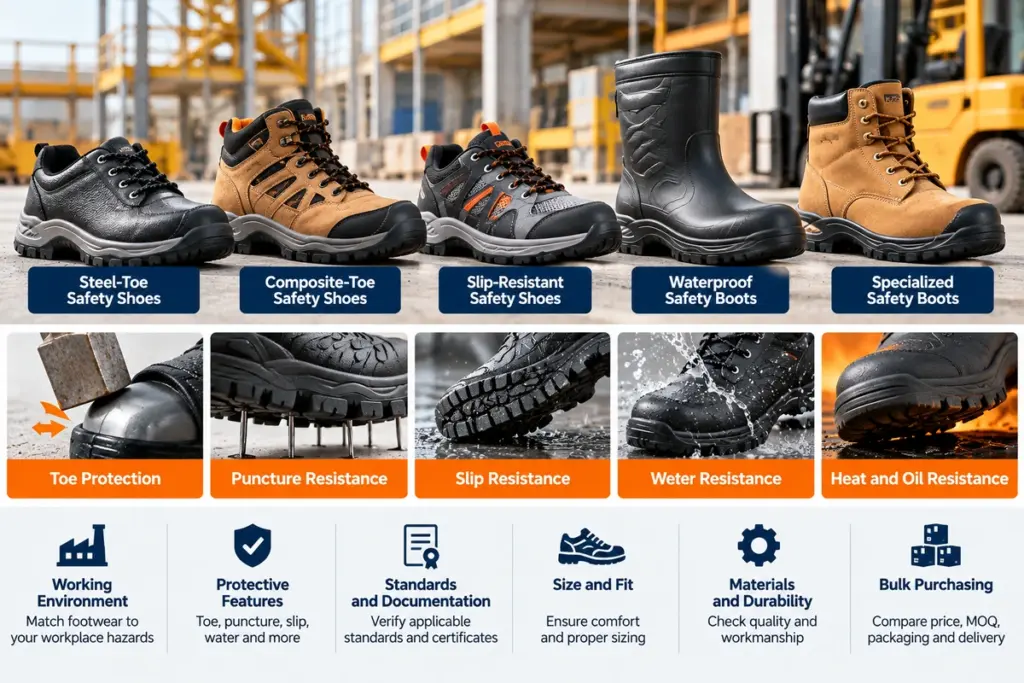
2. Understand the Main Types of Safety Footwear

Safety footwear is available in several designs. The most suitable option depends on the work being performed and the protection required.

Steel-Toe Safety Shoes

Steel-toe footwear uses a steel protective toe cap designed to help protect against specified impact and compression hazards. It may be suitable for construction, manufacturing, warehousing, and other industrial applications where these hazards are present.

Composite-Toe Safety Shoes

Composite-toe footwear uses non-metallic protective materials. Depending on the model, it may be suitable for workplaces where non-metallic footwear is preferred. Buyers should verify the product’s tested protective performance rather than assuming that all composite-toe shoes offer identical protection.

Slip-Resistant Safety Shoes

Slip-resistant footwear is designed to improve traction on specified surfaces and under defined test conditions. Buyers should consider the actual workplace floor, including whether it may be wet, oily, dusty, or contaminated.

Waterproof or Water-Resistant Safety Footwear

For outdoor work or wet environments, buyers may need footwear with verified water-resistant or waterproof properties. These terms are not interchangeable, so the exact performance claim should be confirmed with the supplier.

Specialized Safety Footwear

Some jobs require additional properties, such as resistance to specific chemicals, heat, or electrical hazards. These characteristics must be verified against the relevant product documentation and the workplace risk assessment.

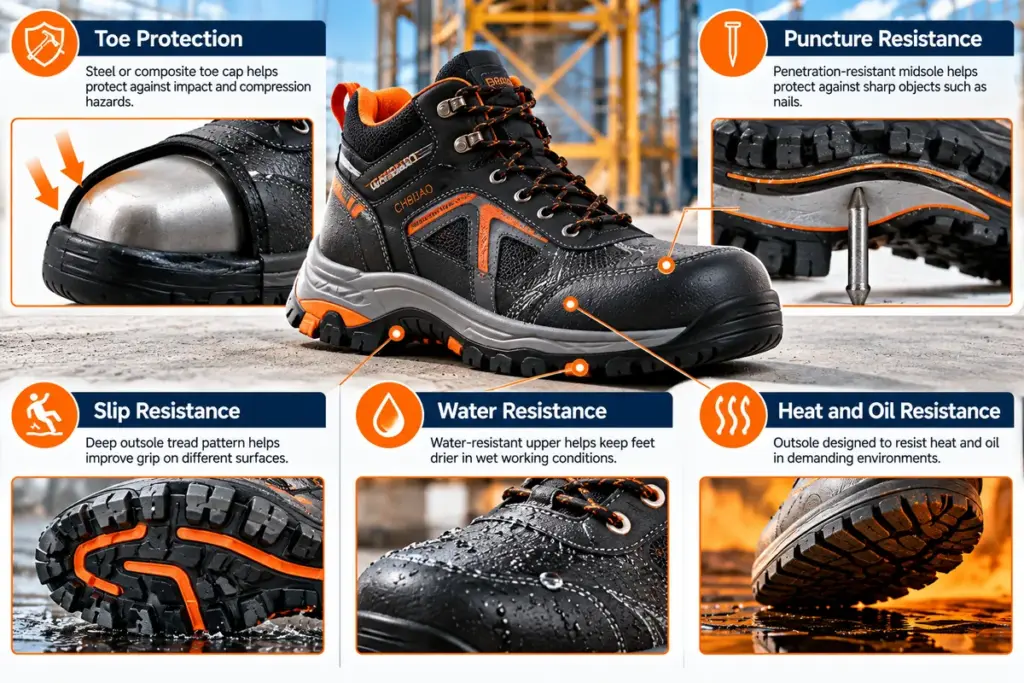
3. Check the Required Protective Features

Before selecting a model, identify the hazards the footwear must address.

  • Toe protection: Confirm the required impact and compression protection.
  • Penetration resistance: Determine whether the sole construction needs protection against nails or other sharp objects.
  • Slip resistance: Check suitability for the actual floor conditions.
  • Water resistance: Confirm whether the job requires water-resistant or waterproof footwear.
  • Heat and oil resistance: Verify outsole properties against the intended operating conditions.
  • Electrical properties: Confirm the specific requirement. Antistatic, electrically insulating, and other electrical footwear properties are different and should not be treated as interchangeable.
  • Chemical resistance: Verify resistance to the specific chemicals involved rather than relying on a general claim.

Not every worker needs every feature. Selecting footwear based on the actual hazards helps buyers avoid both inadequate protection and unnecessary specifications.

4. Verify Standards and Product Documentation

Safety footwear requirements vary by market and application. EN ISO 20345 is a commonly referenced European standard for safety footwear. Other markets may apply different regulations or standards.

Before purchasing, confirm:

  • The applicable standard and edition.
  • The product’s declared protection category and performance claims.
  • Relevant test reports, certificates, or declarations required for the destination market.
  • The manufacturer’s model number and product identification.
  • Whether the documentation matches the exact footwear model being offered.

Do not assume that a supplier’s general certificate covers every product in its range. Verify the scope, validity, issuing body, and model details of the relevant documents.

5. Select the Correct Size and Fit

Even footwear with appropriate protective features may be unsuitable if the fit is poor.

Consider the following when evaluating samples:

  • Available size range and sizing system.
  • Toe-box space and heel stability.
  • Fit when worn with the socks used at work.
  • Comfort during standing, walking, and bending.
  • Weight and flexibility appropriate to the job.
  • Ease of putting on and removing the footwear.

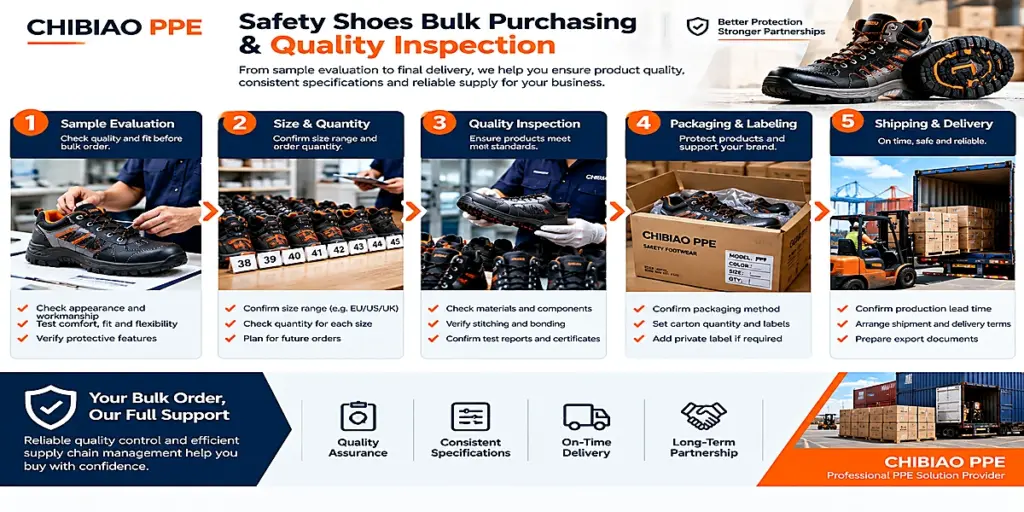
For bulk orders, confirm the size distribution before production or shipment. If possible, evaluate samples across the key sizes rather than relying on a single sample.

6. Evaluate Materials, Outsoles, and Durability

Material selection affects comfort, maintenance, durability, and suitability for the work environment.

Buyers should review the upper material, lining, insole, protective toe cap, and outsole construction. Ask suppliers to clarify the material specifications and the conditions for which the footwear is intended.

When evaluating samples, check stitching, bonding, sole attachment, finishing, and overall workmanship. For repeated bulk orders, agree on the specifications that must remain consistent between batches.

Avoid relying on general descriptions such as “heavy-duty” or “premium quality” without clear product specifications or supporting evidence.

7. Compare Price and Total Purchasing Cost

The lowest unit price does not necessarily represent the best purchasing value. Importers and distributors should compare products with equivalent protective features, specifications, documentation, and packaging.

Include the following in your evaluation:

  • Unit price and minimum order quantity (MOQ).
  • Sample and testing costs, where applicable.
  • Packaging, labeling, and private-label requirements.
  • Production lead time and order quantity.
  • Freight, insurance, duties, and other applicable import costs.
  • Inspection requirements and arrangements for non-conforming products.

For an accurate comparison, request quotations based on the same specification and delivery terms.

8. Evaluate the Supplier

A reliable supplier should be able to explain product specifications, provide relevant supporting documents, communicate clearly, and confirm realistic production and delivery arrangements.

Before placing a bulk order, consider whether the supplier can:

  • Provide clear model-specific specifications.
  • Supply samples for evaluation.
  • Share relevant test documentation.
  • Confirm production capacity and lead time.
  • Support agreed packaging and labeling requirements.
  • Maintain consistent product specifications for repeat orders.
  • Confirm its legal business details and payment information.

For new suppliers, verify the business identity and payment instructions independently before transferring funds.

9. Practical Bulk-Purchasing Checklist

Use this checklist before confirming a safety footwear order.

  • Application: Identify the workplace, tasks, and hazards.
  • Footwear Type: Confirm the required design and protective features.
  • Standards: Verify applicable standards and destination-market requirements.
  • Documentation: Check model-specific specifications and supporting test documents.
  • Sizing: Confirm the size range and quantities required for each size.
  • Samples: Evaluate fit, comfort, grip, and workmanship where appropriate.
  • Specifications: Record the agreed materials, outsole, protective components, and performance claims.
  • Quotation: Confirm unit price, MOQ, currency, and additional charges.
  • Packaging: Specify individual packaging, carton quantities, labels, and private-label requirements.
  • Delivery: Confirm lead time, shipment schedule, and agreed delivery terms.
  • Inspection: Agree on quality criteria and how non-conforming goods will be handled.
  • Payment: Verify supplier details, payment terms, and the Proforma Invoice (PI).
  • Repeat Orders: Establish how specifications and quality consistency will be maintained.

Completing this checklist helps reduce misunderstandings and supports more consistent bulk procurement.

Conclusion

Choosing the right industrial safety shoes requires more than comparing prices or selecting a popular style. Buyers should assess workplace hazards, verify protective performance, check product documentation, evaluate fit and durability, and confirm supplier reliability.

For PPE importers, wholesalers, and distributors, a clear purchasing specification is an important step toward safer product selection and more predictable bulk orders.

Looking for industrial safety footwear for your market? Contact CHIBIAO PPE to discuss your product specifications, sizing requirements, packaging options, and bulk purchasing needs.

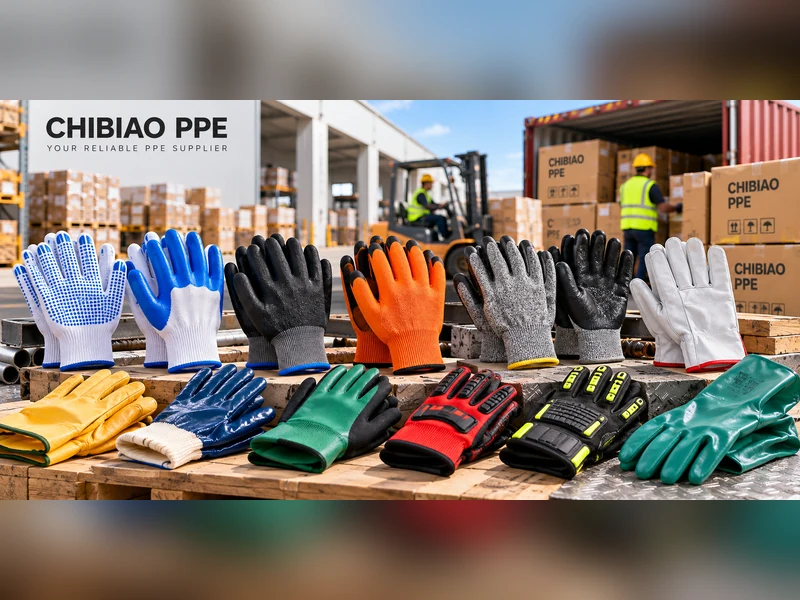
How to Choose the Right Safety Gloves for Industrial Use

Choosing the right safety gloves is essential for protecting workers, improving workplace safety, and controlling PPE purchasing costs. Different industrial tasks involve different hazards, including abrasion, cuts, punctures, chemicals, heat, and general handling risks.

For importers, wholesalers, distributors, and industrial procurement teams, selecting safety gloves requires more than comparing prices. Buyers should evaluate the intended application, glove materials, protection requirements, sizing, quality consistency, and supplier capabilities before placing a bulk order.

This guide explains the key factors to consider when sourcing safety gloves for industrial use.

1. Identify the Intended Application

Start by identifying the tasks workers will perform and the hazards they may encounter.

Common applications include:

  • General warehouse handling and logistics
  • Construction and building maintenance
  • Manufacturing and assembly
  • Mechanical work and equipment maintenance
  • Material handling and packaging
  • Cleaning and selected chemical-handling tasks

Different applications require different glove properties. A glove suitable for general handling may not provide sufficient protection against sharp edges, hazardous chemicals, or high temperatures.

Before selecting a product, define the workplace conditions and the level of protection required.

2. Choose the Right Glove Material

Safety gloves are available in different materials and constructions. Each option has its own advantages and limitations.

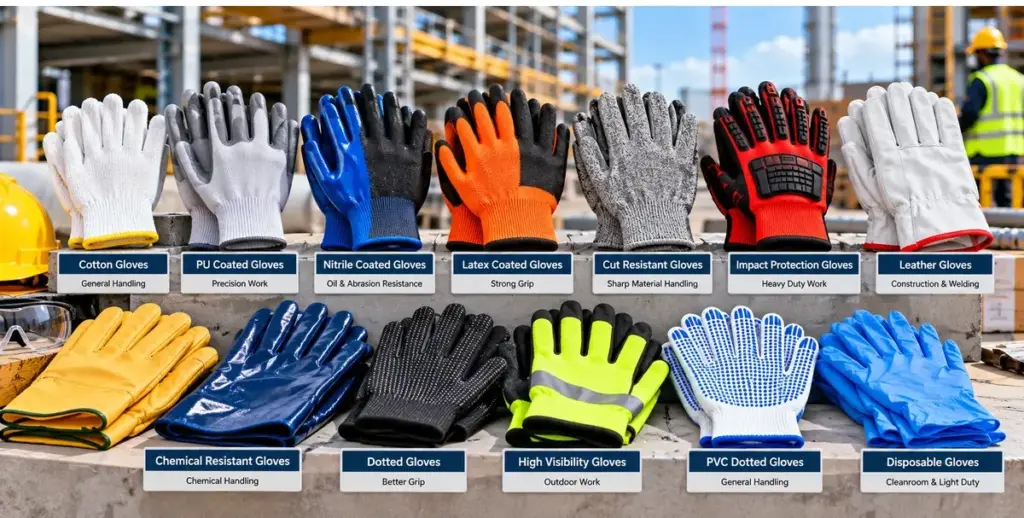
Cotton and General-Purpose Fabric Gloves

Fabric gloves are commonly used for light-duty handling, packaging, and general warehouse tasks. Their suitability depends on the material, construction, and intended application.

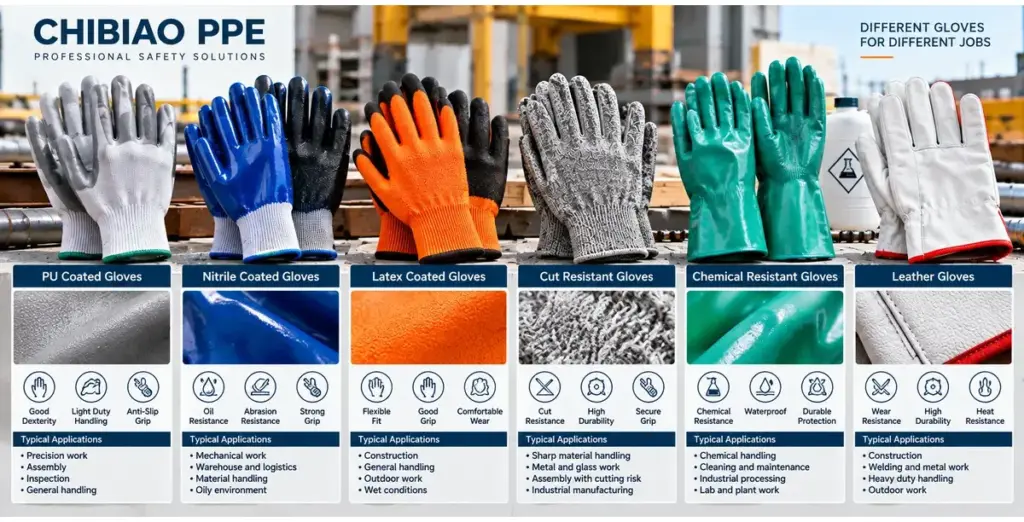
PU-Coated Gloves

Polyurethane-coated gloves are often selected for assembly, inspection, and precision handling where dexterity and grip are important.

Nitrile-Coated Gloves

Nitrile-coated gloves are widely used in mechanical handling, warehousing, and industrial applications where grip and abrasion resistance are needed. Actual performance depends on the coating, liner, and glove design.

Latex-Coated Gloves

Latex-coated gloves can provide a flexible fit and good grip in suitable applications. Buyers should consider latex sensitivity and evaluate whether the product is appropriate for the intended users.

Cut-Resistant Gloves

Cut-resistant gloves are designed for tasks involving sharp materials, metal edges, glass, or other cutting hazards. Buyers should verify the applicable cut-resistance classification and test documentation rather than relying on appearance alone.

Chemical-Resistant Gloves

Chemical-resistant gloves must be selected according to the specific chemical, concentration, temperature, exposure duration, and task. No single glove material is suitable for every chemical.

Always review the manufacturer’s compatibility information and product documentation before purchasing gloves for chemical handling.

3. Check the Required Protection Level

Before ordering, determine which hazards the gloves must address.

Consider the following factors:

  • Abrasion resistance
  • Cut resistance
  • Puncture resistance
  • Tear resistance
  • Grip in dry, wet, or oily conditions
  • Chemical compatibility, where applicable
  • Heat or cold protection, where required

Applicable standards and test methods vary by market and application. For example, EN 388 is commonly used to assess mechanical risks in protective gloves, while EN ISO 374 standards address aspects of chemical and microorganism protection.

Buyers should confirm the current applicable standard, required performance level, and supporting documentation for the destination market. Do not assume that all safety gloves offer the same protection.

4. Select the Correct Size and Fit

A glove must fit the intended user properly. Gloves that are too tight can reduce comfort and dexterity, while gloves that are too loose may affect grip and handling control.

When sourcing gloves in bulk, confirm:

  • Available sizes
  • Size measurement method
  • Fit and flexibility
  • Cuff style and length
  • Whether workers need to perform precision tasks
  • Size distribution required for the order

For large orders, request samples where practical so that the intended users can evaluate fit and comfort before finalizing the specification.

5. Evaluate Grip, Comfort, and Durability

Protection is only one part of glove selection. Workers also need gloves suitable for repeated use and the conditions of their jobs.

Evaluate the following:

Grip: Check whether the glove provides suitable handling performance in dry, wet, or oily conditions.

Dexterity: Consider whether workers need to handle small components, tools, or packaging materials.

Comfort: Review flexibility, breathability, liner construction, and cuff design.

Durability: Evaluate coating adhesion, seam quality, abrasion performance, and consistency between production batches.

Maintenance and replacement: Determine whether the gloves are intended for single use or repeated use, and establish appropriate inspection and replacement procedures.

The lowest unit price does not always represent the lowest overall purchasing cost. Product suitability, service life, worker acceptance, and replacement frequency should also be considered.

6. Confirm Quality and Compliance Documentation

For importers and distributors, consistent product quality is essential.

Before placing a bulk order, request and review relevant documents, which may include:

  • Product specifications
  • Material and construction details
  • Applicable test reports
  • Declarations or certificates required for the target market
  • Product labeling and packaging information
  • Batch identification and quality inspection records, where available

Requirements depend on the product, intended use, and destination market. Buyers should verify the authenticity, scope, and validity of relevant documentation.

Do not rely solely on a supplier’s general statement that a product is “certified.” Confirm that the documentation applies to the exact product model and protection claims being purchased.

7. Plan Your Bulk Purchasing Requirements

Before requesting a quotation, prepare a clear purchasing specification.

Include:

  • Glove type and intended application
  • Required material and coating
  • Protection level and applicable standards
  • Sizes and quantity per size
  • Color and product design
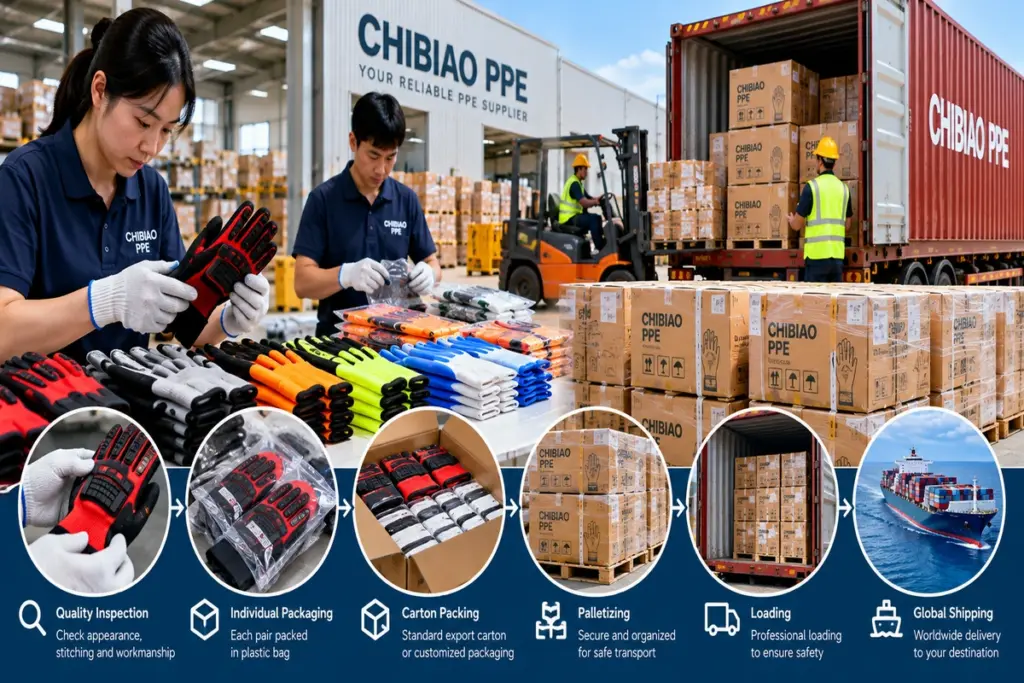
  • Packaging requirements
  • Logo or private-label requirements
  • Destination market
  • Required delivery schedule
  • Inspection and documentation requirements

Also confirm the minimum order quantity, sample availability, production lead time, payment terms, shipping arrangements, and quotation validity.

Providing complete specifications helps suppliers quote accurately and reduces the risk of misunderstandings during production.

8. Evaluate the Supplier

A reliable safety glove supplier should be able to explain product differences and provide information relevant to your application.

When comparing suppliers, consider:

  • Product range and specification clarity
  • Ability to provide samples
  • Consistency of product quality
  • Availability of relevant technical documents
  • Packaging and private-label capabilities
  • Communication and order coordination
  • Production planning and delivery reliability

For distributors and wholesalers, it is also useful to discuss repeat-order consistency and how product specifications will be maintained across future shipments.

9. Safety Gloves Bulk Order Checklist

Use this checklist before confirming your purchase:

  • Intended application and hazards identified
  • Glove material and construction confirmed
  • Required protection level specified
  • Applicable standards and documentation reviewed
  • Sizes and quantities confirmed
  • Samples evaluated, where appropriate
  • Packaging and labeling requirements agreed
  • Logo or OEM requirements confirmed
  • Unit price, MOQ, and payment terms reviewed
  • Production and delivery schedule confirmed
  • Quality inspection requirements agreed
  • Shipping and export documentation clarified

Conclusion

Choosing the right industrial safety gloves requires a clear understanding of workplace hazards, material performance, protection requirements, fit, quality, and purchasing conditions.

For importers, wholesalers, distributors, and industrial buyers, a well-defined specification makes it easier to comp

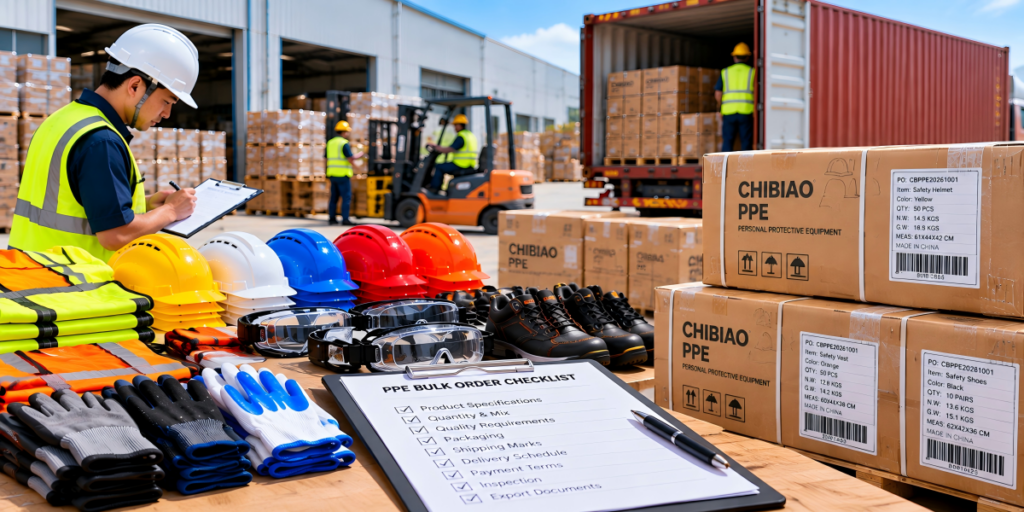
PPE Bulk Purchasing Checklist for Importers

Buying personal protective equipment (PPE) in bulk requires more than comparing unit prices. Importers, wholesalers, distributors, and industrial suppliers need to confirm product specifications, quality requirements, packaging, delivery schedules, and trade terms before placing an order.

A structured purchasing checklist helps reduce misunderstandings, improve supplier communication, and make bulk procurement more predictable.

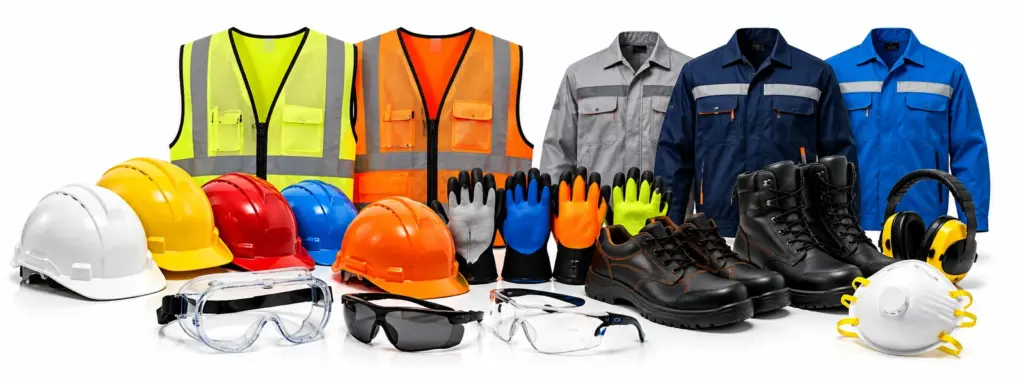
This guide outlines the key points to review before ordering safety helmets, high-visibility safety vests, safety gloves, safety shoes, safety boots, workwear, and other PPE products.

1. Define Your Product Requirements

Start by identifying exactly what your business needs. Avoid requesting a quotation based only on a general product name.

Confirm the following details for each item:

  • Product type and intended application
  • Model or product reference, if available
  • Material and construction
  • Color and available sizes
  • Required features and accessories
  • Applicable safety standards or certification requirements
  • Estimated order quantity

For example, a safety helmet quotation should specify the required helmet type, material, color, suspension system, and any additional features. A safety vest quotation should clarify fabric type, reflective tape, pocket configuration, color, and size range.

Clear specifications help suppliers quote the correct product and reduce the risk of receiving unsuitable goods.

2. Confirm Quantities and Product Mix

Before requesting a quotation, prepare a quantity breakdown.

Check:

  • Total quantity required for each product
  • Quantity by color and size
  • Whether different models will be combined in one order
  • Whether the supplier has minimum order quantities
  • Whether quantities can be adjusted before production
  • Whether samples are required before bulk production

If you purchase multiple PPE categories, list each item separately. Do not rely on a single total quantity for the entire order.

Ask the supplier to confirm whether the quoted price applies to the exact quantity and product mix you intend to purchase.

3. Verify Product Specifications and Quality Requirements

Product appearance alone does not establish suitability for a particular workplace.

Before ordering, confirm the technical specifications and quality requirements that apply to your market and end users.

Review:

  • Material and key dimensions
  • Weight, where relevant
  • Construction and functional features
  • Color consistency and workmanship
  • Packaging condition
  • Applicable test reports or conformity documents, where required
  • Inspection criteria and acceptance requirements

If a product must comply with a particular standard, identify the exact standard and required product category before placing the order. Ask the supplier for relevant documentation and verify that it applies to the specific product being offered.

Do not assume that all products in the same category meet the same requirements.

4. Request and Evaluate Samples

Samples can help you assess product appearance, workmanship, fit, packaging, and suitability before committing to a larger order.

Before requesting samples, agree on:

  • Sample model and specifications
  • Sample quantity
  • Sample price, if applicable
  • Courier and shipping costs
  • Estimated dispatch time
  • Whether the approved sample will be used as the bulk production reference

Record any changes requested after sample evaluation. If the sample is approved, make sure the final quotation and order documents identify the agreed product specifications.

A sample review should support the purchasing decision, but it does not replace any required testing, certification verification, or formal quality inspection.

5. Compare Quotations on the Same Basis

The lowest unit price is not necessarily the most competitive offer.

When comparing suppliers, check whether each quotation covers the same product specification, order quantity, packaging, delivery arrangement, and payment conditions.

Review the following:

  • Unit price and currency
  • Minimum order quantity
  • Tooling, printing, or customization charges, if applicable
  • Packaging costs
  • Sample and inspection costs
  • Freight and insurance responsibilities
  • Applicable trade terms and named delivery locations
  • Quotation validity period

For international orders, confirm the agreed Incoterm and named place or port. Clarify which party is responsible for transportation, export formalities, insurance, and other relevant costs.

Compare the total purchasing cost on a consistent basis rather than comparing unit prices alone.

6. Confirm Packaging and Shipping Marks

Packaging affects product protection, warehouse handling, shipment planning, and distribution.

Before ordering, confirm:

  • Units per inner package or carton
  • Carton dimensions and gross weight, where available
  • Packaging material and protection requirements
  • Product labels and carton markings
  • Shipping marks and consignee information
  • Barcode or private-label requirements, if applicable
  • Palletization requirements, if needed

For customized packaging, approve the artwork and wording before production. Ensure that product labels and markings meet the requirements of your destination market and intended distribution channel.

Request carton and packing information early if you need to estimate shipping volume or freight costs.

7. Agree on Production and Delivery Schedules

A supplier’s estimated lead time should be clearly understood before the order is confirmed.

Ask the supplier to clarify:

  • Whether the products are in stock or require production
  • Estimated production lead time
  • Whether customization will affect the schedule
  • Sample approval and artwork approval deadlines
  • Inspection timing
  • Estimated shipment date
  • Required shipping documents
  • How delays or changes will be communicated

Distinguish between production completion, dispatch, departure, and arrival. These are different milestones.

If your business has a fixed delivery deadline, communicate it before confirming the order and allow time for inspection, transport, customs clearance, and local delivery.

8. Confirm Payment Terms and Order Documents

Before making payment, ensure that the commercial documents accurately reflect the agreed transaction.

Review the following:

  • Seller’s legal company name and contact details
  • Buyer information and consignee details
  • Product descriptions and specifications
  • Quantities and unit prices
  • Total order value and currency
  • Payment schedule and payment method
  • Delivery terms and named location
  • Estimated delivery schedule
  • Packaging requirements
  • Agreed quality requirements
  • Applicable inspection and claims procedures

Check that the Proforma Invoice (PI) matches the final quotation and the terms agreed with the supplier.

For international transactions, confirm the seller’s legal identity and verify payment instructions through a trusted communication channel, particularly when bank details change.

9. Establish Inspection and Non-Conformity Procedures

Agree on how product quality will be checked and how problems will be handled.

Depending on the product and order, discuss:

  • Pre-production or sample approval
  • In-process checks, where applicable
  • Pre-shipment inspection
  • Inspection scope and acceptance criteria
  • Required photographs, reports, or test records
  • Procedure for reporting shortages, damage, or non-conforming products
  • Agreed process for corrective action or commercial resolution

Inspection requirements should be agreed before production or shipment, not introduced for the first time after a problem occurs.

Keep written records of approved samples, specifications, inspection results, and any agreed changes.

10. Evaluate the Supplier’s Communication and Reliability

A reliable supplier should be able to explain the offered product, identify what has and has not been confirmed, and communicate clearly about price, quality, and delivery.

Before committing to a large order, consider:

  • Responsiveness and clarity of communication
  • Ability to provide product specifications
  • Availability of relevant supporting documents
  • Transparency about lead times and limitations
  • Consistency between quotations and order documents
  • Ability to handle packaging or customization requests
  • Clear procedures for resolving issues

For a new supplier, consider starting with samples or a manageable initial order when commercially appropriate. Build larger purchasing commitments as product suitability, communication, and performance are verified.

11. Final Pre-Order Checklist

Use this checklist before confirming your PPE order:

  • Product models and specifications are confirmed.
  • Quantities, sizes, and colors are checked.
  • Applicable standards and documentation requirements are identified.
  • Samples have been evaluated where needed.
  • Prices and additional charges are understood.
  • Packaging and shipping marks are approved.
  • Production and delivery schedules are agreed.
  • Payment terms and seller details are verified.
  • The Proforma Invoice matches the agreed requirements.
  • Inspection criteria and issue-resolution procedures are documented.
  • Required shipping and export documents are confirmed.
  • Final changes have been recorded in writing.

Conclusion

Successful PPE bulk purchasing depends on clear specifications, consistent quotation comparisons, documented quality requirements, reliable communication, and careful order confirmation.

By using a structured checklist, importers and distributors can reduce avoidable purchasing risks and improve coordination with their suppliers.

Planning a bulk PPE order? Contact CHIBIAO PPE to discuss your product requirements, specifications, packaging options, and quotation needs for your target market.

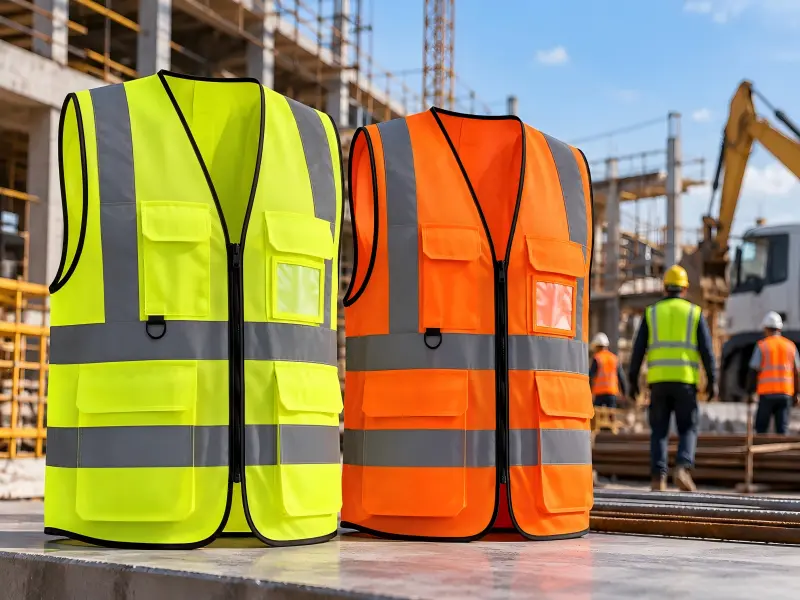
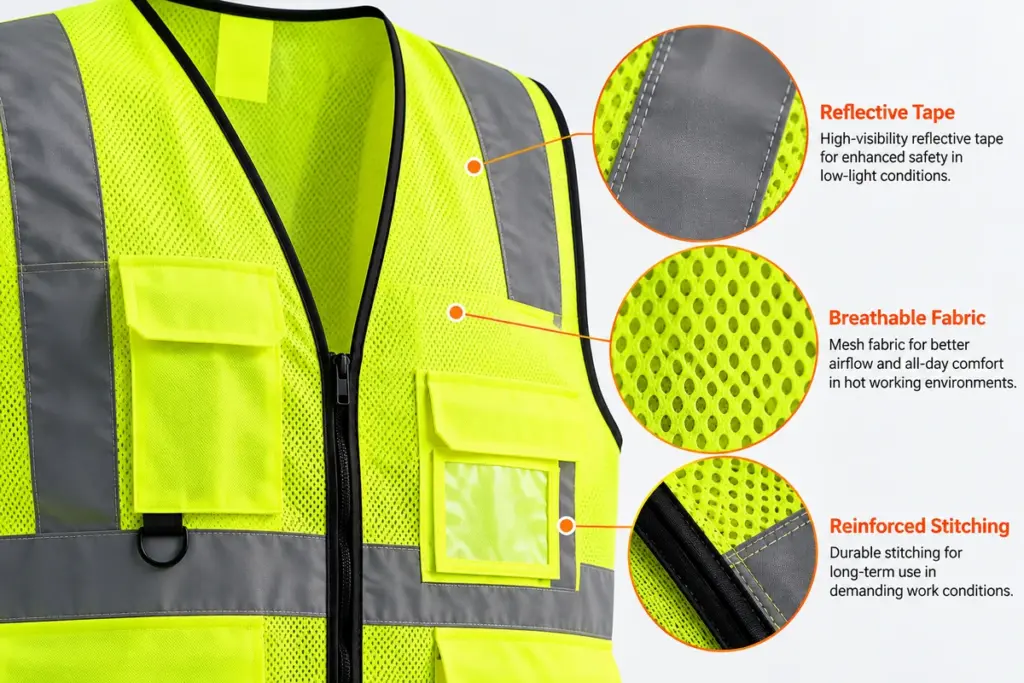
How to Choose the Right High-Visibility Safety Vest

High-visibility safety vests help workers remain visible in environments where moving vehicles, industrial equipment, or low-light conditions create potential hazards. For importers, wholesalers, distributors, and industrial buyers, selecting the right vest means evaluating more than color and price.

1. Identify the Working Environment

Start by understanding where the vest will be used.

  • Construction sites: Consider visibility around vehicles, machinery, and active work zones.
  • Roadwork and traffic management: Evaluate the visibility requirements for workers near moving traffic.
  • Warehousing and logistics: Choose a practical design that supports visibility and daily movement.
  • Outdoor and low-light work: Check whether the garment provides suitable visibility for the intended conditions.

The work environment should guide the vest design, material, and applicable safety requirements.

2. Choose the Right Fabric

Common options include mesh fabric and solid fabric.

  • Mesh vests: Offer airflow and can be suitable for hot working environments.
  • Solid-fabric vests: May provide greater fabric coverage and suit different workplace needs.

Fabric weight, durability, comfort, and stitching quality should be considered together. Buyers should confirm the actual material composition and specifications with the supplier.

3. Check the Reflective Tape

Reflective tape is an important component of a high-visibility vest. Before placing an order, confirm:

  • Tape width and placement
  • Reflective performance and relevant test documentation
  • Resistance to the expected washing and working conditions
  • Compatibility with the intended garment design

Do not assume that all reflective tape provides the same performance. Request product-specific documentation when required.

4. Select the Right Design and Pockets

Vest designs vary according to the tasks workers perform. Some models feature simple front closures, while others include multiple pockets for carrying tools, pens, identification cards, or small work accessories.

For bulk purchasing, confirm the pocket layout, closure type, stitching, sizing, and any customization requirements before approving a sample.

5. Confirm Applicable Safety Standards

Safety requirements vary by country, industry, and intended use. For example, buyers may encounter standards such as ANSI/ISEA 107 in the United States or EN ISO 20471 in relevant international markets.

Confirm the applicable standard, garment classification, labeling, and supporting test documents for the exact model being purchased. Do not rely on a general supplier statement as a substitute for product-specific evidence.

6. Check Sizes, Colors, and Customization

Before ordering, confirm the available sizes, garment colors, reflective-tape configuration, logo printing options, and packaging requirements.

For customized orders, approve the artwork and a representative sample before mass production. Make sure the final specification matches the quotation and purchase order.

7. Evaluate the Supplier

A suitable vest is only part of a successful purchasing decision. Importers and distributors should also assess the supplier’s product consistency, communication, quality-control process, lead time, and ability to meet agreed order quantities.

Ask for clear specifications, product photos, samples where appropriate, and relevant documentation before committing to a large order.

8. Use a Pre-Order Checklist

Before confirming a bulk order, verify the following:

  • Intended work environment and visibility requirements
  • Fabric type and material composition
  • Reflective-tape design and supporting documentation
  • Vest style, pockets, closure, and sizing
  • Applicable safety standards and product-specific evidence
  • Logo, color, and customization requirements
  • Packaging, minimum order quantity, and production lead time
  • Approved sample and final written specifications

Conclusion

Choosing the right high-visibility safety vest requires a balance of visibility, comfort, durability, compliance, and purchasing requirements. By confirming the intended application and exact product specifications before ordering, buyers can reduce misunderstandings and make more informed sourcing decisions.

Looking for high-visibility safety vests for your business? Contact CHIBIAO PPE to discuss your product requirements, customization options, and bulk purchasing needs.

How to Choose the Right Industrial Safety Helmet

Choosing the right industrial safety helmet is an important part of workplace safety and PPE procurement. For importers, wholesalers, distributors, and industrial buyers, selecting a suitable helmet involves more than comparing prices. Product design, material, suspension system, working environment, applicable safety requirements, and supplier reliability should all be considered.

This guide explains the key factors buyers should review when sourcing industrial safety helmets.

1. Identify the Intended Working Environment

Start by identifying where and how the helmet will be used. Construction sites, manufacturing facilities, warehouses, utilities, and other industrial environments may have different head-protection requirements.

Before selecting a product, buyers should clarify the workplace hazards and consult the applicable workplace safety rules and product standards for the destination market.

Do not assume that one helmet design is suitable for every application.

2. Compare Helmet Shell Materials

Industrial safety helmets may be available in different shell materials, depending on the product design and intended application.

When comparing options, buyers should review:

  • The material specified by the manufacturer
  • The intended application and environmental conditions
  • The product’s applicable safety standards and test documentation
  • The manufacturer’s care, inspection, and replacement instructions

Material alone does not establish whether a helmet meets a particular safety requirement. Buyers should verify the complete product specification and supporting documentation.

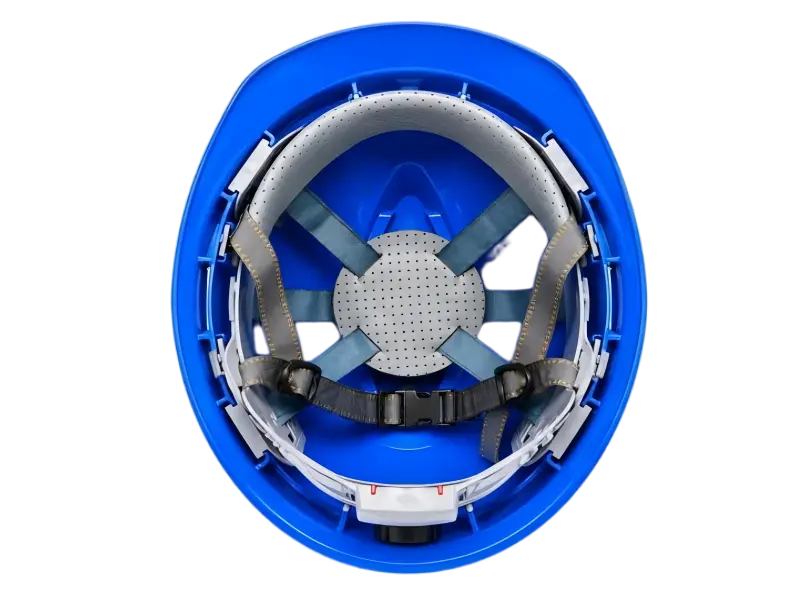
3. Check the Suspension System and Fit

The suspension system helps position the helmet on the wearer’s head. Buyers should confirm the suspension design, adjustment method, fit range, and compatibility with the intended use.

Important questions include:

  • How many suspension attachment points does the product have?
  • Is the headband adjustable?
  • Can the helmet be fitted securely and comfortably?
  • Are replacement suspension components available?
  • Are accessories compatible with the helmet model?

The number of suspension points and the product’s construction should be confirmed from the actual product specification rather than assumed from appearance.

4. Consider Ventilation and Accessories

Vented and non-vented helmet designs may be available for different working conditions. Buyers should determine whether ventilation is appropriate for the intended hazards and the requirements of the destination market.

Where accessories are required, check compatibility before ordering. Depending on the product design, accessories may include face shields, hearing protection, chin straps, or other approved components.

Never assume that an accessory is compatible with every helmet model.

5. Verify Standards and Product Documentation

Before placing a bulk order, identify which safety standards and regulatory requirements apply in the destination market.

Ask the supplier for relevant documentation, such as:

  • The exact product model and specification
  • Applicable conformity or certification documents, where required
  • Available test reports and their scope
  • Manufacturer instructions for use, inspection, and maintenance
  • Product labels and packaging information

Verify that the documents correspond to the exact model being purchased. Do not rely on general claims or documents for a different product.

6. Review Product Specifications Before Ordering

A clear specification helps prevent misunderstandings between the buyer and supplier.

Confirm the following details in writing:

  • Product model and shell material
  • Helmet color and available options
  • Suspension design and adjustment method
  • Product weight, where relevant
  • Applicable standards and documentation
  • Logo printing or other customization requirements
  • Packaging method and quantity per carton
  • Sample availability, production lead time, and order quantity

If several versions of a helmet are offered, make sure the quotation, approved sample, and final order refer to the same specification.

7. Evaluate the Supplier

For importers and distributors, a suitable product is only one part of a successful purchasing decision. Supplier communication, specification accuracy, quality control, packaging, and order coordination also matter.

Before committing to a large order, consider requesting a sample, reviewing available company and product documentation, and confirming the agreed specifications in the quotation and purchase order.

Buyers should also clarify how product changes, quality issues, and replacement requests will be handled.

8. Use a Practical Purchasing Checklist

Before confirming an order, check that you have:

  • Defined the intended application and hazards
  • Confirmed the required product standard for the destination market
  • Reviewed the shell material and suspension specification
  • Checked fit, color, accessories, and customization requirements
  • Verified the relevant product documentation
  • Approved the sample or agreed reference specification
  • Confirmed packaging, order quantity, and delivery arrangements

Conclusion

Choosing the right industrial safety helmet requires a structured review of the intended application, product design, suspension system, applicable safety requirements, documentation, and supplier capability.

For PPE importers, wholesalers, and distributors, written specifications and verified product documentation help reduce purchasing misunderstandings and support more consistent sourcing decisions.

Looking for industrial safety helmets for your market? Contact CHIBIAO PPE to discuss your product requirements, available specifications, customization options, and bulk-order needs.

PPE Buying Guide: How to Choose the Right Personal Protective Equipment

Choosing the right personal protective equipment (PPE) is essential for workplace safety, regulatory compliance and effective procurement. For importers, wholesalers, distributors and industrial buyers, selecting suitable PPE requires careful consideration of the work environment, product specifications, applicable standards and order requirements.

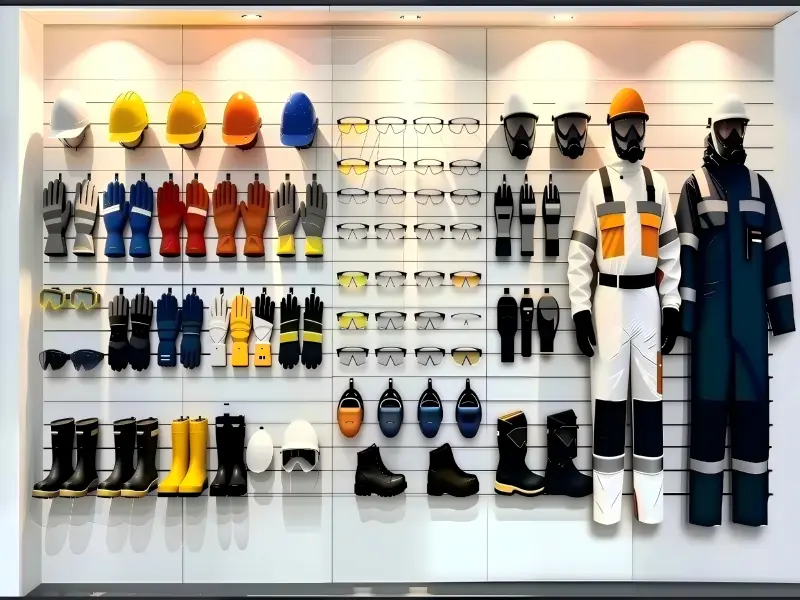
This guide introduces the key factors to consider when sourcing safety helmets, high-visibility vests, protective gloves, safety footwear, safety goggles and workwear.

1.Identify the Workplace Hazards

Before selecting PPE, identify the hazards workers may face in their specific work environment. These may include falling objects, impact, sharp edges, chemical splashes, dust, excessive noise, poor visibility and slip hazards.

The required protection depends on the task, exposure level, workplace conditions and applicable safety requirements. Buyers should consult workplace risk assessments and relevant safety professionals when determining suitable protective equipment.

2.Select PPE According to the Required Protection

Choose PPE based on the hazards identified and the level of protection required for each task. Different products serve different purposes, and one product may not be suitable for every working environment.

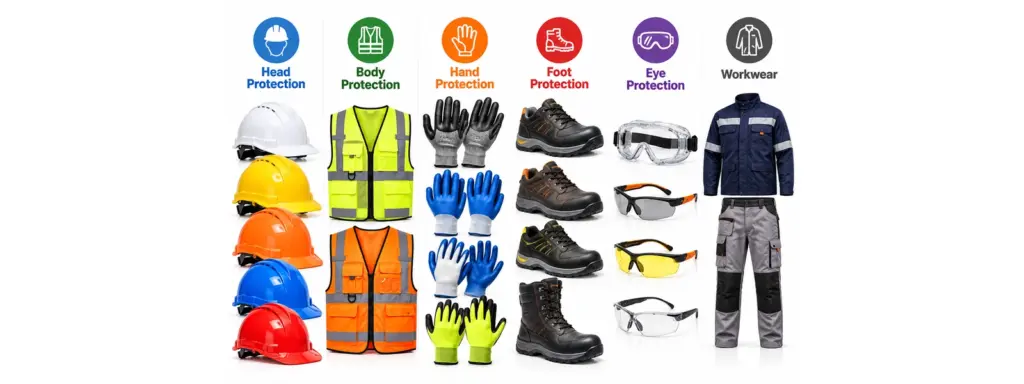
  • Head Protection: Safety helmets and bump caps, selected according to impact risks and workplace requirements.
  • Body Protection: High-visibility safety vests and workwear, chosen according to visibility needs, weather conditions and job tasks.
  • Hand Protection: Protective gloves selected according to the materials handled and the risks of abrasion, cuts, chemicals or other hazards.
  • Foot Protection: Safety shoes and boots selected according to the required toe protection, sole properties, workplace conditions and applicable standards.
  • Eye Protection: Safety goggles and protective eyewear selected according to risks such as dust, particles and chemical splashes.

Always verify product specifications and suitability for the intended application before purchasing.

3.Check Product Standards and Compliance

PPE product standards and compliance requirements vary by product type, intended use and destination market. Before placing an order, buyers should identify the standards and regulatory requirements applicable to their products and country of import.

When requesting a quotation, ask suppliers to provide relevant test reports, certificates or other compliance documents where applicable. Check that the documents match the specific product model, materials and specifications being offered.

Do not assume that every PPE product meets the same standards. Confirm the applicable requirements and supporting documentation before order confirmation.

4.Confirm Product Specifications and Order Details

Before confirming an order, buyers and suppliers should agree on the exact product specifications and purchasing requirements. Clear documentation helps reduce misunderstandings and supports smoother order processing.

Key details to confirm include:

  • Product model and type
  • Materials, colors, dimensions and weight, where applicable
  • Required sizes and product configurations
  • Order quantities and acceptable tolerances
  • Packaging, labeling and private-label requirements
  • Destination country and applicable compliance requirements
  • Quotation validity, lead time, shipping terms and payment terms

Make sure the final specifications and agreed commercial terms are documented in the quotation, purchase order or other relevant order documents before production or order processing begins.

5.Evaluate Supplier Reliability and Supply Capabilities

Selecting a reliable PPE supplier involves more than comparing unit prices. Buyers should assess the supplier’s ability to provide clear product information, consistent communication and order arrangements that match the agreed requirements.

Before placing an order, consider the following:

  • Product Information: Are specifications, materials, product images and relevant documents available for review?
  • Communication: Does the supplier respond clearly to technical and commercial questions?
  • Quality Requirements: Can inspection criteria and acceptance requirements be agreed upon before order confirmation?
  • Supply Arrangements: Are minimum order quantities, production or sourcing lead times, packaging and shipping arrangements clearly explained?
  • Documentation: Can the supplier provide the order documents and applicable product compliance records required for the transaction?

For important or large-volume orders, confirm key requirements in writing and clarify responsibilities before making payment or authorizing order processing.

6.Request Samples and Confirm Before Bulk Purchasing

For new suppliers, unfamiliar products or large-volume orders, buyers may consider requesting samples before committing to a bulk purchase, where samples are available.

Use the sample review to check product appearance, workmanship, dimensions, materials and other agreed specifications. Where relevant, review product labels, packaging and supporting compliance documents as well.

Before proceeding with a bulk order, confirm the final product model, specifications, sample approval status, quantities, pricing, lead time, packaging and delivery arrangements in writing.

Sample availability, costs and lead times should be agreed with the supplier in advance. A sample review does not replace any required formal testing, certification or regulatory verification.

7.Request a PPE Quotation

When requesting a PPE quotation, provide as much detail as possible so the supplier can evaluate your requirements accurately.

Please include:

  • Product names, models or reference images
  • Required specifications, materials and colors
  • Estimated order quantities for each product
  • Destination country and delivery location
  • Applicable standards, certificates or project requirements
  • Branding, logo printing and packaging requirements, if needed
  • Target delivery schedule and any special purchasing conditions

CHIBIAO PPE welcomes inquiries from importers, wholesalers, distributors, industrial suppliers and project procurement teams. Share your requirements through our Request a Quote page so we can review suitable product options and discuss the next steps.

8.Need Help Selecting the Right PPE?

Choosing suitable PPE for your business depends on your workplace hazards, product specifications, destination market and purchasing requirements.

Contact CHIBIAO PPE to discuss your product needs, bulk order requirements or OEM & ODM options. Visit our Request a Quote page and share your product list, estimated quantities and destination country so we can review your inquiry and discuss suitable options.